

Introduction
Severe erectile dysfunction affects many men, often after a long medical journey marked by progressively less effective treatments. When pills, injections, or external devices no longer allow for a sufficient erection, a penile implant now represents the most reliable and lasting solution.
This procedure has been performed for several decades and benefits from major technological advances: stronger materials, more discreet devices, extremely low infection rates, and very stable results. The goal is not to alter the patient’s anatomy, but to replace a failing biological mechanism with a discreet and effective internal system.
The aim of this article is to present in a clear and comprehensive manner the functioning of the penile implant, the different models available, the procedure and the expected benefits, while answering the most frequently asked questions from patients.
What is a penile implant?
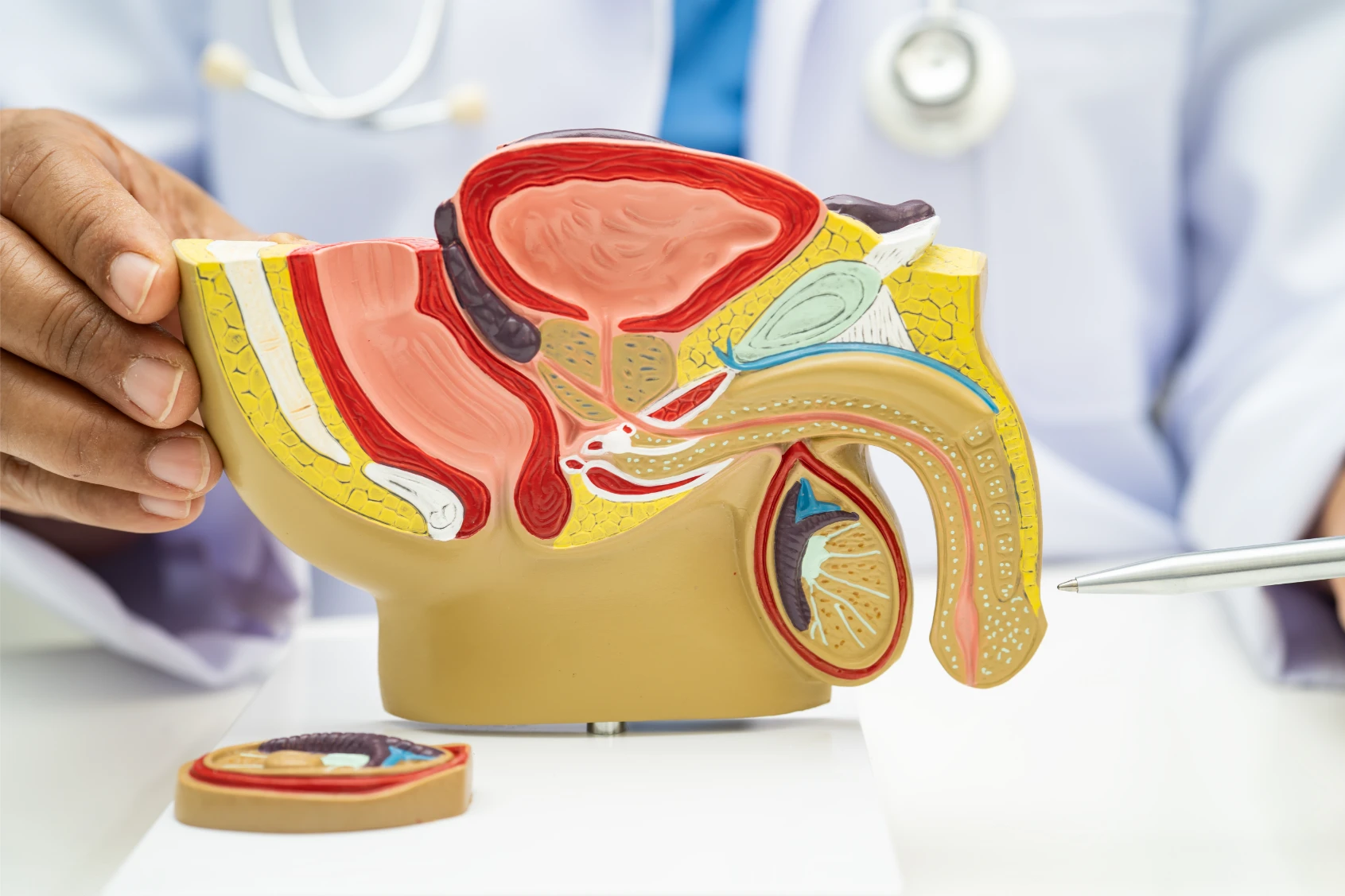
A penile implant — also called a penile prosthesis — is a fully internal device placed inside the corpora cavernosa. It replaces erectile function when natural mechanisms fail.
Contrary to some misconceptions, the implant does not change:
✔ Penile sensitivity,
✔ the ability to reach orgasm,
✔ ejaculation (except in cases of pre-existing disease),
✔ the external appearance of the penis.
Its sole purpose is to ensure sufficient rigidity during intercourse. This device is invisible, undetectable, and does not alter the appearance of the penis at rest.
The implant is now considered the standard treatment for severe erectile dysfunction resistant to medical treatments.
For which men is a penile implant indicated?
The indication depends on the patient’s history, their state of health, and their expectations.
The implant is generally recommended in the following situations:
1️⃣ Severe erectile dysfunction resistant to treatment
When oral treatments become ineffective, poorly tolerated, or contraindicated.
2️⃣ Failure or loss of effectiveness of intracavernous injections
Certain pathologies lead to fibrosis of the corpora cavernosa, making injections ineffective over time.
3️⃣ Post-prostatectomy or pelvic surgery
After a radical prostatectomy for cancer, erectile function may be permanently impaired. An implant is then a particularly suitable solution.
4️⃣ Peyronie’s disease associated with erectile dysfunction
In cases of severe curvature with an inability to obtain a rigid erection.
5️⃣ Complicated diabetes (vascular involvement of the penis)
Diabetic patients are common among candidates for penile prosthesis.
6️⃣ Neurological pathologies
Spinal cord injury, multiple sclerosis, neuropathies.
7️⃣ Older men but in good general health
There is no real age limit. Many men over 60 or 70 years old benefit from this procedure with excellent results.
Each case is analyzed individually during the urology consultation.
The different types of penile implants
Today, there are two main families of penile implants :
- The malleable (or semi-rigid) implant and the hydraulic (or inflatable) implant .
Both models allow for a rigid erection, but their operation, daily comfort, and natural appearance differ.
The choice of implant model is always made during a consultation, taking into account the patient’s age, medical condition, manual dexterity, anatomy, and preferences. The goal is to offer an implant that is both reliable and suitable for daily life.
1. The malleable (semi-rigid) penile implant
The malleable implant is the simplest system from a mechanical standpoint. It consists of two flexible rods implanted in the corpora cavernosa. These rods remain in a semi-rigid position at all times.
How does the malleable implant work?
The penis remains in a state of moderate rigidity.
For everyday life, the patient can discreetly point the penis downwards; for intercourse, it is enough to reposition it forwards.
There is no complex handling , no button to press, no internal mechanism: this is precisely what makes it a very reliable model.
In what cases is a malleable implant preferred?
This model is often recommended by:
✔ Patients with reduced mobility or limited dexterity ,
✔ Men seeking a robust and very easy-to-use solution
✔ Patients with severe fibrosis of the corpora cavernosa,
✔ Men who have had multiple pelvic surgeries,
✔ Patients at risk of infection or with significant comorbidities.
Advantages of the malleable implant
- Extremely simple to use: no pump, no reservoir.
- Virtually no mechanical risk: very few parts, therefore very few breakdowns.
- Shorter surgery than for hydraulic implants.
- Long-term reliability, particularly in frail patients.
Points to know
- The penis remains in a semi-permanent state of rigidity, which may be uncomfortable for some men.
- The appearance at rest is less natural than that obtained with a hydraulic prosthesis.
Despite this, the malleable implant provides excellent rigidity and great ease of use.
2. The hydraulic (inflatable) penile implant
Hydraulic implants are the current gold standard technology.
It allows for the reproduction of an erection much closer to the natural mechanism, with a penis that is soft at rest and rigid on demand.
There are two main types:
✔ 2-piece hydraulic implants,
✔ 3-piece implants , which are the benchmark standard in terms of naturalness and comfort.
How does the hydraulic implant work?
The system consists of:
- two cylinders implanted in the corpora cavernosa,
- a pump concealed in the scrotum,
- a reservoir filled with liquid (for 3-piece implants),
- a valve allowing deflation.
To get an erection:
The patient presses the pump located in the scrotum → the liquid is transferred into the cylinders → the penis becomes rigid.
To return to a flaccid state:
Pressing the valve allows the liquid to return to the reservoir → the penis becomes soft again.
All of this is completely invisible.
Preferred indications for hydraulic implants
This model is often recommended when the patient is looking for:
✔ A finish as close to natural as possible,
✔ Spontaneous and comfortable sexuality,
✔ Total control of erection,
✔ A high-end device with excellent comfort at rest.
Advantages of the malleable implant
- A very natural flaccid state: maximum flexibility at rest.
- Rigid erection on demand, close to a natural erection.
- Optimal aesthetic result, ideal for everyday life.
- Total discretion: nothing is visible or palpable without a specific examination.
- Very high satisfaction rate among patients and their partners.
Points to know
- A little learning is required in the first few weeks.
- The mechanism contains more parts, and therefore a very low but existing long-term mechanical risk.
- The procedure requires a slightly longer surgery.
Quick comparison between the two models
| Malleable Implant | Criterion | Hydraulic Implant |
|---|---|---|
| Appearance at rest: | Semi-rigid, | very natural |
| Activation: | No manipulation required. | Pump in the scrotum. |
| Discretion | Good | Excellent |
| Complexity | Very simple | More sophisticated |
| Permanent | Rigidity | On Demand |
| Surgery duration: | Shorter, | Moderate |
| Patient satisfaction: | High | , Very high |

Procedure, hospitalization and recovery
Penile implant surgery is a specialized procedure, expertly performed by urologists trained in andrology. It follows a clear process, with successive steps designed to ensure a safe, effective, and patient-friendly procedure.
Pre-operative consultation: an essential step
Before any decision is made, a thorough consultation is conducted to understand:
✔ History of erectile dysfunction,
✔ The treatments tried and their results,
✔ the patient’s expectations,
✔ any associated pathologies,
✔ Preferences regarding the type of implant.
The surgeon explains in detail the procedure of the operation, the usual after-effects, the possible risks and the expected benefits.
This step allows the patient to approach the procedure with confidence.
Procedure of the intervention
The procedure takes place in the operating room, under general or spinal anesthesia depending on the medical file.
It lasts on average between 30 minutes and 1 hour , depending on the type of implant placed.
Here are the main steps:
1️⃣ The incision
The surgeon makes a 3 to 4 cm incision:- at the base of the penis (penoscrotal route),
- or at the level of the perineum (perianal route),
2️⃣ Preparation of the corpora cavernosa
The corpora cavernosa are opened and then gently dilated to create the space needed for the implant.
This step is precise and meticulous: it aims to preserve as much fabric as possible and avoid any tension on the surrounding structures.
3️⃣ Implant placement
The components of the prosthesis are then positioned:
- Malleable stems in the case of a semi-rigid implant.
- Cylinders, pump and reservoir in the case of a hydraulic implant.
Each part is carefully adjusted to ensure optimal performance.
The surgeon specifically ensures:
- the correct positioning of the cylinders,
- comfortable mobility of the pump within the scrotum,
- due to the absence of tension on the tissues,
- of the patient’s future comfort.
4️⃣ Implant Test
Before suturing, the system is tested:- pump activation (for hydraulic implants),
- return to a flaccid state,
- evaluation of the aesthetic result.
5️⃣ Closing the incision
A fine suture is performed, then a compression dressing is put in place to reduce postoperative edema.

Hospitalization
The length of hospital stay is generally one to two nights .
Meanwhile, the medical team is keeping watch:
- to the proper management of pain,
- to monitoring the scar,
- in the absence of fever or infection,
- to ensure the patient’s comfort during the initial movements.
Simple painkillers are usually sufficient.
A suspensory is sometimes recommended to support the penis and limit swelling.
Recovery: timelines and recommendations
1️⃣ The first few days
Swelling, some bruising and discomfort are normal.
They fade within one to two weeks.
The patient is able to walk the very next day.
It is advisable to avoid sudden movements, long periods of sitting, and strenuous activity.
2️⃣ Resumption of activities
- Sedentary work : 7 to 10 days
- Physical work : 3 to 4 weeks
- Sport : gradual return after 4 to 6 weeks
- Driving : usually after a few days
In all cases, the urologist adapts the recommendations to the patient’s profile.
3️⃣ Resumption of intimate life
Resumption of sexual relations is possible 4 to 6 weeks after the procedure , once healing is complete and the swelling has subsided.
For hydraulic implants, an initial training session is often conducted so that the patient can handle the pump naturally and with confidence.
When to consult a doctor?
Although complications are rare, you should contact a urologist if you experience:
- Intense, persistent pain
- significant redness
- suspicious leak
- fever,
- unusual difficulty in operating the pump.
Care is always provided quickly, and careful follow-up is ensured.
Results, satisfaction, psychology and impact on intimate life
Expected results after penile implant surgery
After the recovery period, the implant allows you to obtain:
1️⃣ Sufficient rigidity for satisfactory ratios
Current implants provide effective, stable and controlled rigidity.
Whether equipped with a malleable or hydraulic model, the objective is the same: to restore a fully usable erectile function.
2️⃣ An erection on demand (hydraulic implants)
Hydraulic implants offer a function very close to that of a natural erection:
- Subtle flexibility at rest
- rigidity when desired,
- the ability to prolong the erection for as long as desired.
3️⃣ A natural aesthetic finish
Modern models are designed to respect the patient’s anatomy.
The shape of the penis at rest is natural, and the erection obtained is harmonious.
4️⃣ A stable long-term solution
Implants have an average lifespan of 10 to 15 years, sometimes longer depending on the model and use. Some studies show functional devices more than 20 years after implantation.
Patient satisfaction rate
International studies report a satisfaction rate of over 90–95% .
These results can be explained by:
- the recovery of a satisfying sex life,
- the reliability of the device,
- the absence of drug dependence,
- spontaneity restored
- Comfort for the couple.
Very often, patients report the same phrase:
“I should have done it sooner.”
Positive psychological impact
Prolonged erectile dysfunction creates a loss of confidence, frustration, and sometimes a form of shame or withdrawal.
The penile implant therefore also has an effect on the psychological dimension.
🔹Improving self-image
Regaining stable sexual function improves self-esteem.
The men describe a feeling of a return to “normality”.
🔹 Reduced performance anxiety
One of the most burdensome elements is the fear of failure.
With an implant, this anxiety almost completely disappears: rigidity is guaranteed.
🔹 Emotional weight relief
Many men live long lives in silence, sometimes isolating themselves.
The possibility of reliving relationships without uncertainty brings lasting peace.
🔹 Improved mood and overall well-being
The positive consequences often extend beyond the private sphere:
- renewed energy,
- better confidence in public
- sleep improvement,
- disappearance of a heavy mental burden.

Impact on couple's life
A penile implant can profoundly transform the dynamics of a couple, especially when erectile dysfunction was a source of tension or avoidance.
1️⃣ A more serene sexuality
Spontaneity returns, without stress, without calculation, without apprehension.
The relationships have become fluid and natural again.
2️⃣ Improved communication
Many couples explain that this intervention reopened a dialogue they no longer dared to initiate.
3️⃣ Rebuilding complicity
Renewed intimacy fosters a more stable emotional connection.
Some couples even speak of a “second intimate life”.
4️⃣ Role of the partner in the process
It is often beneficial to involve the partner in the decision-making process.
Understanding how the implant works, knowing what to expect, sharing fears… all of this helps to strengthen harmony in the couple.
Intimate life after 60
Sexuality does not end with age.
A large number of men over the age of 60 or 70 continue to have legitimate expectations regarding their intimate lives.
Penile implants are a particularly suitable solution for seniors in good general health.

The observed benefits are often very significant:
- renewed vitality,
- improved confidence,
- feeling of regained youth,
- improved relationship quality.
The procedure lasts approximately 30 minutes and recovery is relatively quick, making it a perfect option for older men.
Testimonies often reported by patients
I've returned to a normal life.

I no longer have that fear that paralyzed me.
My relationship is better.
I thought it was too late for me, but no.
That's a huge weight off my shoulders.
These testimonials confirm the overall impact of the implant, both on sexual function and on emotional well-being.
Risks, complications, implant lifespan and medical follow-up

Possible risks and complications
Complications remain rare , but it is essential to know their nature in order to make an informed decision.
1️⃣ Infection (rare)
This is one of the main risks, even though it affects less than 1 to 3% of patients in specialized centers.
Modern implants often have antibacterial coatings , and surgery is performed under strict aseptic conditions, which greatly limits this risk.
In the event of a confirmed infection, it may be necessary to temporarily remove the implant before inserting a new one once the area has healed.
2️⃣ Transient pain or discomfort
Moderate discomfort is common in the first few weeks, while the swelling subsides.
The pain is usually well controlled with simple analgesics.
3️⃣ Hematoma
A hematoma may appear in the scrotal or penile area.
It disappears in a few days or weeks with appropriate local care.
4️⃣ Mechanical malfunction
Primarily concerned with hydraulic implants, this risk remains low thanks to the current quality of the devices.
It could be a fault in the pump, cylinder, valve or reservoir.
In this case, a second intervention is sometimes necessary.
5️⃣ Erosion or extrusion (exceptional)
In rare cases, the implant can exert excessive pressure on the tissues, leading to weakening of the skin.
This complication is very rare and more frequent in frail patients or those with an infection.
Overall, serious complications remain exceptional , especially when the procedure is performed by a specialist surgeon.
Penile implant lifespan
Penile implants are designed to last for several years .
The average lifespan is estimated at:
- 10 to 15 years for hydraulic implants,
- sometimes more depending on the model and use.
- Malleable implants may have an even longer lifespan due to the absence of an internal mechanism.
Patients can sometimes keep their implant for much longer, particularly in the absence of mechanical problems or infection.
When the implant reaches the end of its lifespan or if a mechanical component shows signs of weakness, replacement surgery may be considered.
Maintenance and upkeep
The majority of implants do not require any special maintenance .
For hydraulic implants, learning how to operate the pump is essential in the first few weeks.
Once this phase is over, its use becomes intuitive.
It is recommended:
- to regularly operate the pump (for hydraulic implants) once healing is complete,
- to follow the urologist’s instructions,
- to attend the follow-up consultations.
Medical follow-up after implantation
Regular monitoring is essential to ensure patient comfort and proper functioning of the device.
Here is the usual schedule:
1️⃣ Early postoperative monitoring
In the days following the procedure, to check the healing, the absence of infection and the correct positioning.
2️⃣ 1-month follow-up appointment
Initial functional assessment.
For hydraulic implants: introduction to pump operation.
3️⃣ 3-month follow-up appointment
Evaluation of comfort, sexual relations, overall satisfaction.
4️⃣ Consultation at 6 months (if necessary)
Final assessment of the first semester.
5️⃣ Annual follow-up
A simple clinical examination is sufficient to ensure that everything is functioning correctly.
The follow-up is an opportunity to ask all questions and adjust some advice if necessary.
Price and refund in France

In France, penile implants are fully reimbursed by the national health insurance system as part of medical coverage:
- cost of the implant,
- surgical fees,
- hospitalization costs.
Fee overruns may occur, particularly in private clinics.
The patient can request a quote and check the reimbursement conditions of their health insurance.
Alternatives to penile implants, FAQ & conclusion
Alternatives to penile implants: what options are there before resorting to them?
Penile implants are a particularly effective solution, but they are only considered after other treatments have failed or are impossible.
Here are the alternatives that are generally suggested as a first option:
1️⃣ Oral treatments (PDE5 inhibitors)
Sildenafil, tadalafil, vardenafil…
These medications are often the first line of treatment.
They can be effective when vascular mechanisms are still partially functional.
2️⃣ Intracavernous injections
Alprostadil is injected directly into the corpus cavernosum.
This method provides a satisfactory erection in some patients, but is not always well tolerated (pain, fibrosis) and may lose its effectiveness over time.
3️⃣ Vacuum devices (vacuum pumps)
They allow for the creation of a mechanical erection through a cylinder and a penile ring.
A useful but often restrictive, less spontaneous and sometimes uncomfortable solution.
4️⃣ Psychosexual therapies
Indicated when the origin of the disorder is psychological or when performance-related stress aggravates the problem.
They can be complementary to a medical approach.
5️⃣ Hormone therapy
If a testosterone deficiency is identified, treatment may be offered.
However, these are specific cases.
When these treatments fail or are not possible, the penile implant becomes the most reliable and lasting solution.
Frequently Asked Questions (FAQ)
Here are the most frequently asked questions from patients and their partners.
Is the implant visible?
No. The device is entirely internal.
At rest, there is no visible difference compared to a natural penis.
Is the procedure painful?
Moderate discomfort may persist for a few days, but simple painkillers are usually sufficient to control it.
After 2 to 3 weeks, the majority of patients no longer feel any pain.
Is it possible to have an orgasm with a penile implant?
Yes.
The placement of an implant does not affect:
- orgasm,
- the sensation,
- ejaculation (unless a pre-existing pathology already impairs it).
Does the implant increase penis size?
No.
The goal is to restore functional rigidity, not to increase size.
The surgeon chooses the implant size that best matches the patient’s natural anatomy.
Can I do sports after the procedure?
Yes, but not immediately.
Most activities can be resumed after 4 to 6 weeks, once healing is complete.
Can a penile implant malfunction?
Malleable implants have an extremely low mechanical risk.
Hydraulic implants, which are more sophisticated, may present a very low risk of long-term malfunction.
In this case, surgical revision may be considered.
Can I travel or go through security checks with an implant?
Yes.
The implant does not trigger any detection systems (airports, security gates, etc.) and does not interfere with any daily activities.
How long should I wait before resuming an intimate life?
Sexual intercourse is usually possible 4 to 6 weeks after the procedure, when all structures are fully healed.
Videos by Dr. Sébastien Beley to learn more
To better visualize how the penile implant works and the procedure itself, you can watch these explanatory videos by Dr. Sébastien Beley:
How does a hydraulic penile implant work?
Penile implant: can it be broken? Risks and reliability
Sexuality after penile implant: what to expect?
Conclusion: a reliable, discreet and durable solution

The penile implant is currently the most effective solution for restoring an erection in men suffering from severe erectile dysfunction resistant to treatment.
It is a safe, reliable procedure, offering one of the highest satisfaction rates in urology.
Patients particularly appreciate:
- the reliability of the result,
- the complete discretion of the device,
- spontaneity rediscovered in intimate life,
- the positive impact on confidence and well-being,
- the lasting improvement of the couple’s relationship.
Each situation is unique, and the choice of an implant should always be guided by an open dialogue with a specialist urologist.
With current techniques, the placement of a penile implant not only restores satisfactory sexual function, but also improves overall quality of life.
Sources and references
✔ Manchester Urology – Penile implants: patient information
https://www.manchesterurology.com/patient-education/penile-implants/
✔ European Association of Urology (EAU) – Management of erectile dysfunction
https://uroweb.org/guidelines/sexual-and-reproductive-health/chapter/management-of-erectile-dysfunction
✔ Mayo Clinic – Penile implants: indications, types and procedure
https://www.mayoclinic.org/tests-procedures/penile-implants/about/pac-20384916
✔ Cleveland Clinic – Surgical penile implants: objectives, risks and recovery
https://my.clevelandclinic.org/health/treatments/10054-surgical-penile-implants